Rustic Canyon

The History of Rustic Canyon

Four miles of creek, canopy, and very good stories.

Rustic Canyon is a secret hiding in plain sight. It runs four miles through the middle of the Westside, thousands of commuters skirt it every day on Sunset and Chautauqua, and yet most Angelenos couldn’t point to it on a map. That suits the people who live here. Over a century and a half the canyon has been a rancho, a beach camp, a railroad dream, a eucalyptus experiment, a private club for Hollywood’s merry drinkers, a movie star’s hideaway, a would-be fortress, and an artists’ colony — a Los Angeles dream zone that has, more than once, been somebody’s idea of utopia.

Much of what follows draws on Rustic Canyon and the Story of the Uplifters, the 1975 history compiled by canyon residents Thomas, Betty Lou, and Randy Young, and on screenwriter Marc Norman’s affectionate 1992 profile of the canyon for Los Angeles magazine, written when he lived here himself. Sources are listed at the end.

Scroll
Before the name

A creek, a canopy, and ten degrees of shade
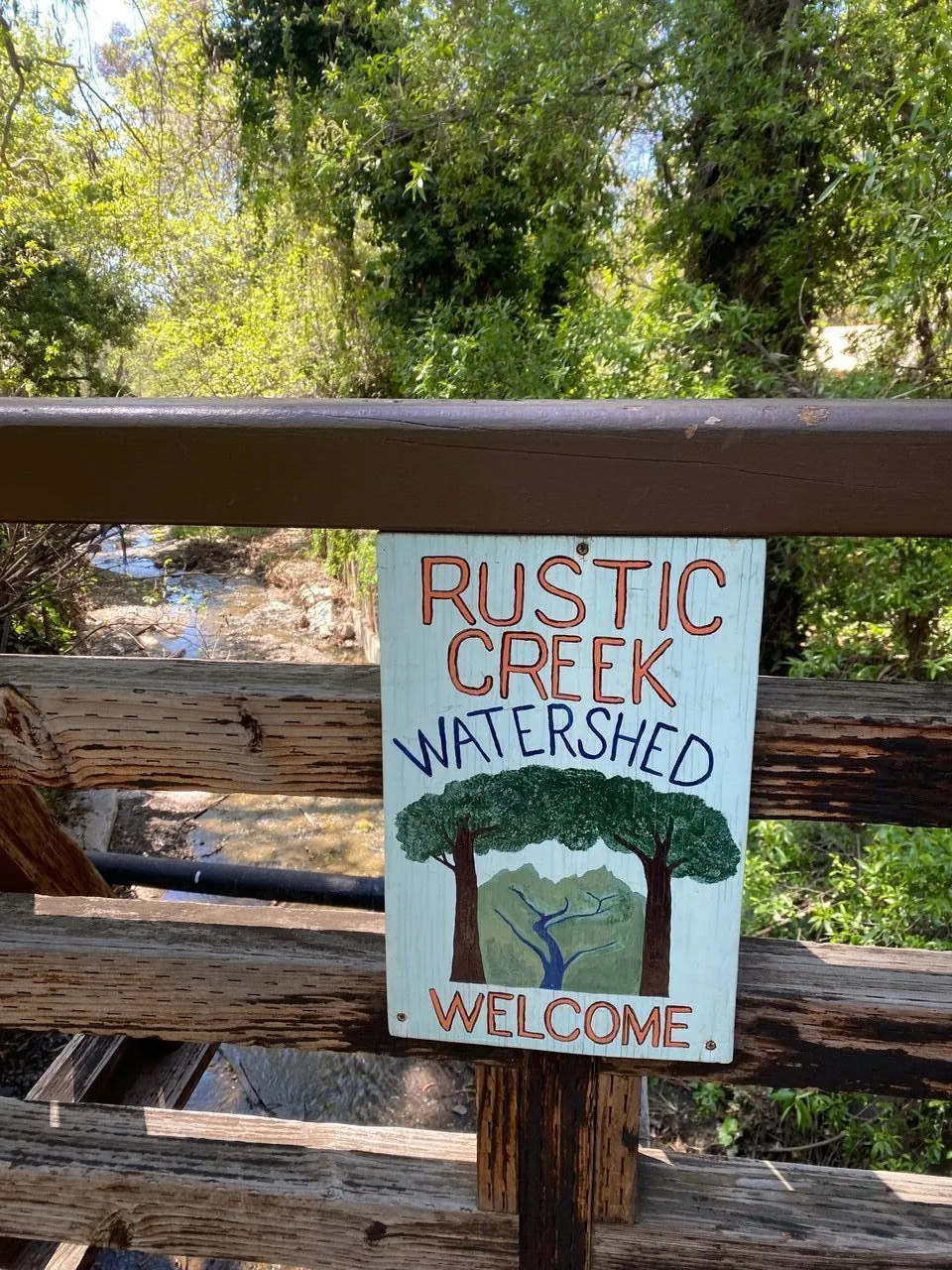
Rustic Canyon street sign beneath a canopy of trees
Under the canopy — the canyon's streets still feel like country lanes

Rustic Canyon runs four miles from the hills below Mulholland to the bluff above the Pacific, following Rustic Creek — the last free-flowing, unchannelized stream in Los Angeles County.

Rustic Canyon runs about four miles, from the hills below Mulholland down to the wide alluvial bluff above the Pacific — the southernmost of the finger canyons that includes Topanga, Temescal, and Potrero. What sets it apart is water: Rustic Creek is the last free-flowing, unchannelized stream in Los Angeles County, still running over stones between banks of oak, sycamore, and eucalyptus, with the state's southernmost natural stand of redwoods along its course.

The canyon floor sits a good ten degrees cooler than the flats in summer and fills with spring fog. The people who lived here first — the Tongva, called “Fernandeño” by the Spanish after the mission that claimed them — fished from canoes off the beach and drew their water from the creek, leaving little behind but footprints.
1830s–1870s

Rancho grazing land and the first weekenders

Stagecoach from the pueblo, a tent on the sand, and a stove to cook on — Rustic Canyon's beach was a resort before it was a neighborhood.

In the 1830s the Marquez, Reyes, and Sepulveda families secured grazing rights from the alcalde downtown for the meadows running from Topanga south to what is now Montana Avenue — the same rancho story told on our Santa Monica Canyon history page.

By the 1870s two hotels had opened on the beach at the canyon's mouth, and Angelenos came out by stagecoach for a day in the sun. Those who couldn't get a room camped on the sand in tents outfitted with stoves and army cots — the weekend getaway, in its earliest form.

1887

Abbot Kinney's eucalyptus experiment

The eucalyptus lining Rustic Canyon's bluffs descend from Abbot Kinney's 1880s forestry test plots — an experiment that outlived the railroad it was meant to serve.

Before he built Venice, Abbot Kinney bought 147 acres of Rustic Canyon in 1887 and planned a fashionable residential district served by a railroad he intended to run from the Santa Monica depot up the canyon's steep sides. The railroad never came, but Kinney had another passion: eucalyptus. As chairman of the California Board of Forestry, he established the nation’s first forestry experiment station in the canyon that same year, on six acres donated by Senator John P. Jones and Arcadia Bandini de Baker. More than 75 varieties of eucalyptus were test-planted there.

The station is now California Historical Landmark No. 840; a few acres survive in a grove south of Rustic Canyon Park, and the descendants of Kinney's plantings line the canyon's blufftops today. It's a family connection for me — my great-grandfather came to the Westside to work with Kinney on the Venice canals.

1892–1920

The port that almost was

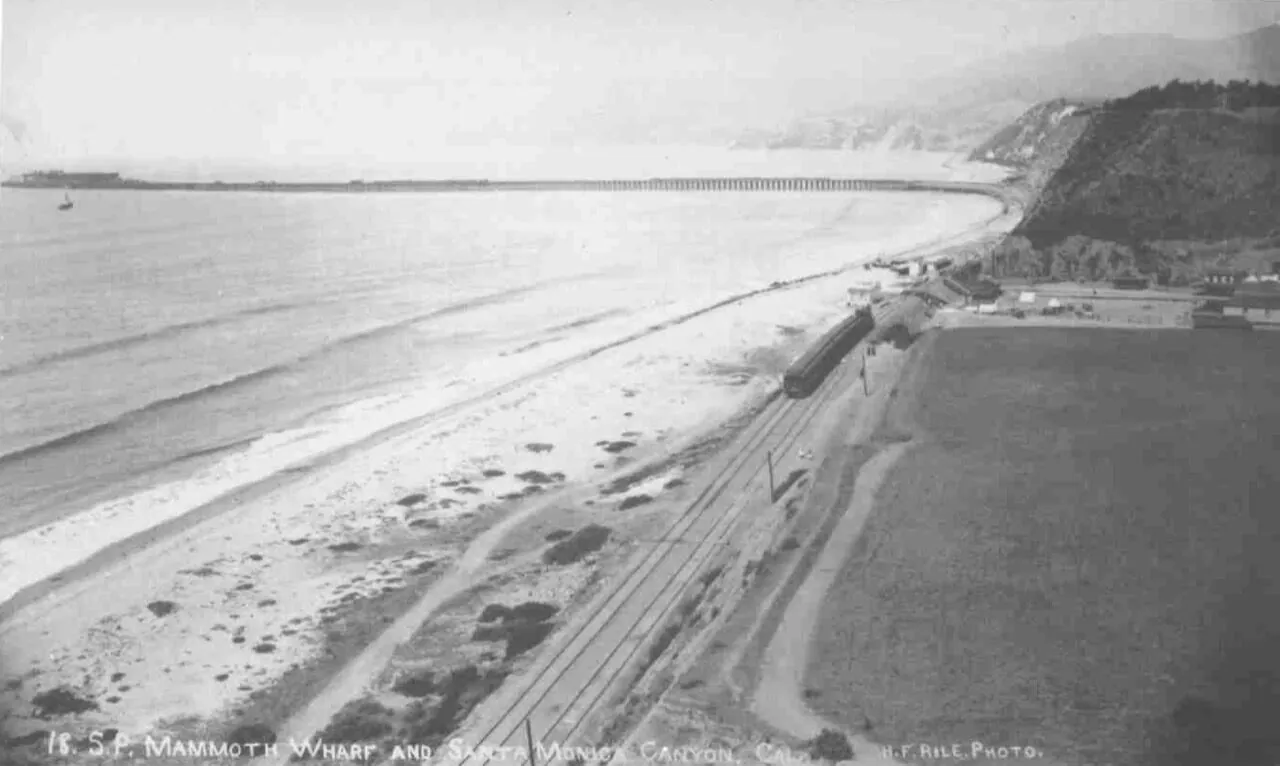
Aerial view of the Long Wharf extending into Santa Monica Bay north of Rustic Canyon, 1890s
The Long Wharf at Potrero Canyon, 1890s

In 1892 the Long Wharf went up at Potrero Canyon, the next ravine north, in a bid to put the port of Los Angeles at Rustic Canyon’s doorstep. San Pedro won the fight, and the wharf came down in 1920.

Near the turn of the century, Rustic Canyon nearly became San Pedro. Los Angeles had no deep-water port, and Nevada senator John P. Jones — who preferred Santa Monica as a place to live — argued for building it at the canyon's mouth, with Charles Crocker and Collis P. Huntington as allies. In 1892 they financed the Long Wharf at Potrero Canyon, the first ravine north of Rustic: a mile of timber running out into the bay.

San Pedro won the political fight, the wharf rotted, and it was dismantled in 1920. What the wharf left behind was a village of Japanese abalone divers and fishermen on the beach to the north — an early Malibu — and a canyon suddenly connected to the world.

1890s–1910s

The first families

Kit Carson's nephew was among the canyon's earliest residents — living in a shack of flattened fuel tins on what is now Evans Road.

Rustic Canyon's first private home belonged to George Edmond, a Johns Hopkins–educated geologist who had come west for his health, and his wife Katherine. The Gillis family followed; their handyman, Sam Carson — a nephew of the scout Kit Carson — lived in a hut made of flattened kerosene cans where Evans Road now runs.

Santa Monica became the city's beach resort when the Southern Pacific streetcar arrived, and by 1894 there were enough canyon children to justify a school. Canyon School still stands, its original building intact in the middle of the playground.

1913–1921

The Uplifters find their canyon

L. Frank Baum christened the Uplifters' officers — Grand Muscle, Royal Hoister, Lord High Raiser — and Prohibition sent the club looking for a canyon of its own.

The Uplifters began in 1913 as an offshoot of the Los Angeles Athletic Club, gathered by a gregarious businessman named Harry Haldeman. L. Frank Baum, author of the Oz books, delivered the founding report — and named the officers the Grand Muscle, the Elevator, the Royal Hoister, and the Lord High Raiser. They gave generously to hospitals and the poor, and they threw banquets, sang, told jokes, and enjoyed a drink.

When Prohibition arrived in 1919, the club wanted a place near the city where it could gather in peace. They considered Big Bear, then settled on Rustic Canyon, buying 40 acres from the Edmond family in 1920 and 81 more over the following decade. In the fall of 1921, Haldeman led a convoy of members from downtown to show off what became known simply as the Ranch.

1920s

Building the Ranch

Three log cabins from a 1923 movie were trucked down from Lake Arrowhead and reassembled in the canyon. One is still a home on Haldeman Road.

By 1925 the Uplifters had put thousands of dollars into roads, terraces, and retaining walls built from creek stone, plus a baseball field, two tennis courts, a swimming pool, a trapshooting range, and bridle paths. Members leased lots and built weekend cabins — and the cabin motif was set when Marco Hellman bought three log cabins built at Lake Arrowhead for the 1923 film The Courtship of Miles Standish, hauled them to Rustic Canyon, and rebuilt them whole. One still stands on Haldeman Road.

Friday nights meant the High Jinks around the campfire circle, a Wild West–flavored pageant with music by composer Louis Gottschalk. In 1928 the club built a polo field bounded by Sunset and what are now Brooktree and Hightree roads, and riding became the sport of choice — the friendly link between the Uplifters and their neighbor across Sunset, Will Rogers. Women, it should be said, weren't permitted to stay overnight on the Ranch until 1935.

1924–1935

Will Rogers' canyon

During the 1934 flood, Will Rogers rode down to the washed-out Sunset bridge and spent the night warning drivers away by lantern light.

Will and Betty Rogers bought 176 acres of mesa and canyon from Japanese gardeners in 1924 — not because they needed a home, but because Will wanted a quiet place to get away from films and newspaper columns. What began as a one-bedroom weekend cabin grew into the ranch house that is now a state park. He cleared a polo field, built trails and corrals, and laid out a nine-hole golf course to entertain a friend recovering from a plane crash in the apartment over his garage.

The family moved to the ranch permanently in 1928. When the 1934 flood took out the bridge over Rustic Creek at Sunset, Will rode down the hill with a lantern and spent the night warning motorists. That same year he built a hideaway cabin a mile up the canyon — double rock fireplaces, a chuck-wagon door, bunk beds. He barely got to use it; he died with Wiley Post in Alaska the following year. The cabin later burned, but its chimney still stands, a steep hike down from Casale Road.

1933–1941

The compound in the upper canyon

The concrete powerhouse and terraced stairways still stand; the city removed the water tank and gate in 2016. The rest of the story lives somewhere between county records and campfire.

County records from 1933 show “Jessie Murphy, a widow” buying fifty-odd acres north of the Rogers property. The real owners were Norman Stephens, an engineer with silver-mining interests, and his wife Winona, an industrialist's daughter drawn to the supernatural. Local lore holds that Winona fell under the sway of a German sympathizer who convinced the couple that war and anarchy were coming, and that the chosen few would need somewhere to wait it out.

What followed was a decade of construction: an enormous concrete water tank, a concrete diesel power station with walls a foot thick, terraced orchards, an electrified fence, and a hillside refrigerated locker. Welton Becket was hired, Lloyd Wright sketched, and in 1941 Paul Williams drew plans for a 22-bedroom mansion that was never built. Rumors of drills and gunfire drifted through the canyon. The FBI arrived the day after Pearl Harbor, and the Murphy Ranch — as everyone still calls it — was over. How much of the story is fact and how much is canyon legend remains a matter of debate.

1947–1953

The Uplifters' last hurrah

Uplifters' Ranch, painted across Latimer Road — the club has been gone since 1947, but the name never left.

The Depression ended the party. Members couldn't keep up their mortgages to the association, the polo field had overstretched the budget, and ranch homes began selling — first to fellow members, then to outsiders. The club folded in 1947. An attempt to run the clubhouse as a racquet club failed, and in 1953 the buildings, ball field, pool, and tennis courts passed to the City of Los Angeles as Rustic Canyon Park.

A faded sign reading Uplifters' Ranch still hangs across Latimer Road as you approach the park from the south, and the cabins, stone walls, and the Uplifter spirit — arty, a little eccentric, devoted to the good life outdoors — remain.

1948–1965

Huntington Hartford's artists' colony

Edward Hopper and Andrew Wyeth both took residencies in Lloyd Wright–designed studios in upper Rustic Canyon.

The last of the canyon's utopias was artistic. In 1948 Huntington Hartford, heir to the A&P grocery fortune, bought the Murphy Ranch remains and founded a colony modeled on MacDowell and Yaddo. He hired Lloyd Wright to design a cluster of studio-residences with north-facing skylights, scattered through the upper-canyon meadows, and offered nationally known artists six-month residencies free of everyday distraction.

Edward Hopper came to stay, as did Andrew Wyeth, Max Eastman, Van Wyck Brooks, and Mark Van Doren. The Huntington Hartford Foundation cost its patron about $100,000 a year; in 1965 his financial advisers insisted he stop, and the colony closed.

1930s onward

The people who guard it

In the 1930s, spotting a real-estate agent on East Rustic Road was grounds for a chase. The canyon has been protective of itself ever since.

The canyon has always attracted people who wanted to be left alone with the trees. In the 1930s the photographer Edward Weston lived in the lower canyon with his sons Brett and Cole, near the sculptor Holger Jensen. The whole street worried about overbuilding, and the story goes that when a real-estate agent was spotted coming up East Rustic Road, Mrs. Jensen and Mrs. Weston would chase her back down it. As a fourth-generation local who now sells homes here, I take that in the spirit intended.

That protectiveness became organized. The Homeowners Association of Rustic Canyon keeps the roads paved and throws a well-attended block party each year, and it was among the first neighborhood groups in the city to train residents in fire response and disaster preparedness. When Rustic Creek flooded in 1969, neighbors slogged sandbags side by side. They've since fought off a freeway to the Valley and a proposed landfill beyond Camp Josepho. Today The Canyon Alliance, on whose board I serve, carries that work forward across the historic neighborhoods of Rustic and Santa Monica Canyons.

1947–today

Architecture in the trees

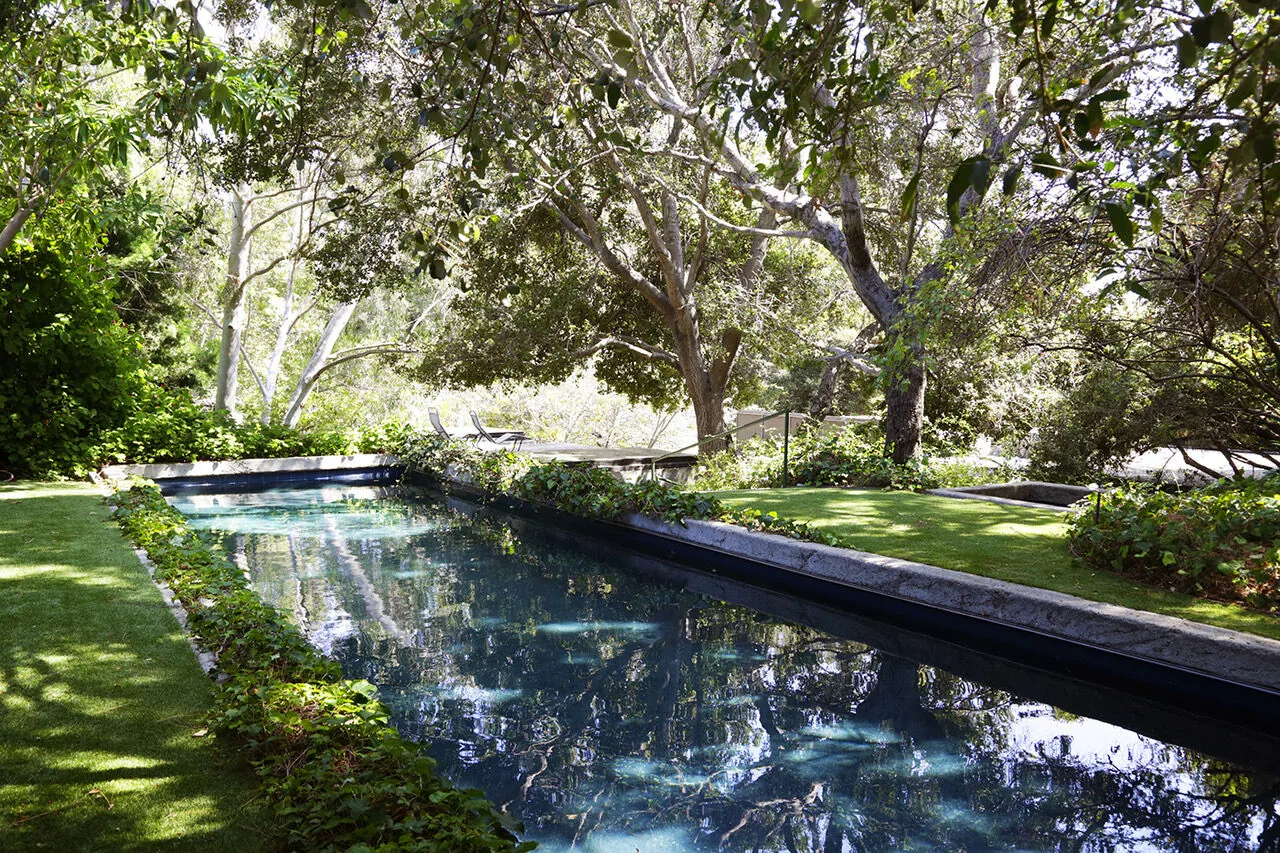
Ray Kappe-designed home in Rustic Canyon with pool and canyon trees
A Ray Kappe house in the canyon — redwood, glass, and trees

Ray Kappe, Charles Moore, Richard Neutra, Cliff May, Lloyd Wright and Kenneth Lind all built here — houses that sit in the trees rather than on top of them.

Rustic Canyon's houses are rarely ostentatious, but many are special. Ray Kappe built several of his redwood, steel, and glass masterworks here. There are Marshall Lewis houses in his Sea Ranch idiom, a Charles Moore house on Latimer, a number of Neutras, and a Lloyd Wright house long associated with the Newman family. A rambling Cliff May ranch house went up in 1947, and Kenneth Lind’s mid-century houses sit quietly among the oaks — including one on Hilltree Road whose sellers I represented in 2026. The mix is eclectic — and somehow it all belongs.

The canyon that Abbot Kinney once imagined as a fashionable district reached by rail became something better: a place where people who could afford a palace chose a cabin. Explore what that looks like today on our Rustic Canyon neighborhood page.

Why this history matters when you buy here

Every one of these stories left something behind — the creek-stone walls, the Uplifters’ cabins, the eucalyptus on the bluffs, the way a house sits in the trees rather than on top of them. It’s also why buying in Rustic Canyon takes a local: drainage on a creek lot, hillside geology, which parcels sit in the city and which don’t, and a homeowners’ association that has been paying attention since the 1930s. I grew up one canyon over and I’m glad to walk you through it.

— Alex

Questions People Ask About Rustic Canyon

Where is Rustic Canyon?

Rustic Canyon runs roughly four miles from the hills below Mulholland Drive down to the coastal bluff, between Santa Monica Canyon and Pacific Palisades on the Los Angeles Westside. It carries a Pacific Palisades address but sits within the City of Los Angeles.

Who were the Uplifters?

A social club founded in 1913 as an offshoot of the Los Angeles Athletic Club and named by Wizard of Oz author L. Frank Baum. In 1920 the Uplifters bought land in Rustic Canyon for a country retreat — the Uplifters Ranch — with a clubhouse, pool, tennis courts, polo field, and weekend cabins. The club folded in 1947; the clubhouse and grounds became Rustic Canyon Park in 1953.

Why are there so many eucalyptus trees in Rustic Canyon?

Abbot Kinney established the nation’s first forestry experiment station in Rustic Canyon in 1887, test-planting more than 75 varieties of eucalyptus. The gum trees along the canyon’s bluffs descend from those plantings.

What is the Murphy Ranch?

The ruined 1930s compound in upper Rustic Canyon built by Norman and Winona Stephens — a large water tank, a power station, and terraced grounds — which local lore says was meant as a self-sufficient retreat for Nazi sympathizers. Federal agents arrived the day after Pearl Harbor. Huntington Hartford’s artists’ colony later occupied the site (1948–1965). In 2016 the city demolished most of the structures, including the water tank and gate; the concrete powerhouse and the trail remain.

Sources: Thomas R. Young, Betty Lou Young, and Randy Young, Rustic Canyon and the Story of the Uplifters (1975). Marc Norman, “Hermit Chic,” Los Angeles magazine, May 1992, pp. 62–69. Will Rogers State Historic Park, California State Parks. Figures and dates are as reported in these sources; where the record is disputed, this page says so.

Newsletter
More canyon stories, once a month

“10 Good Things” — Alex's newsletter on canyon life, Westside real estate, and a few things worth your time.

The canyon is still writing its story

If you're looking to become part of it, Alex would love to show you around.